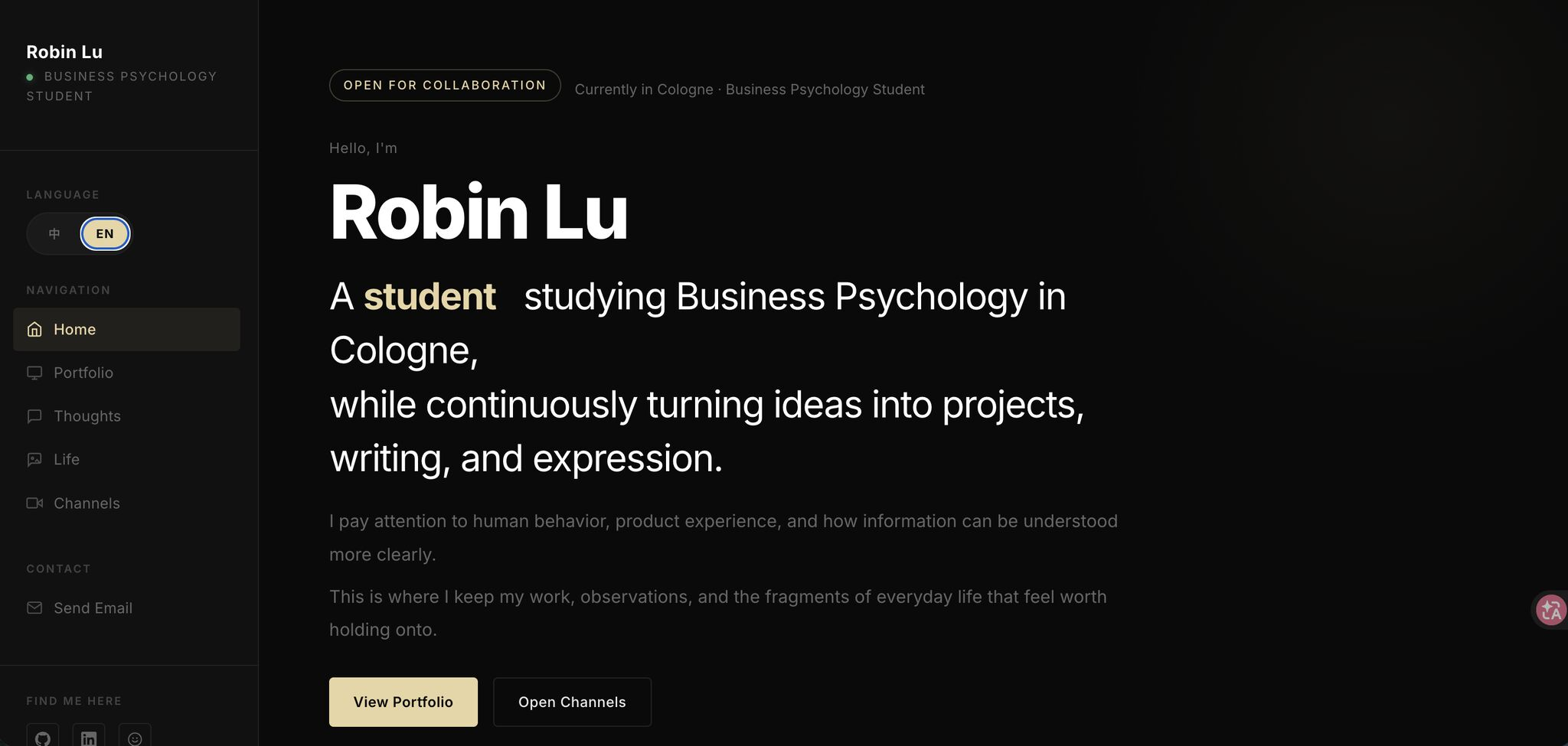
个人主页系统:把个人表达做成一个可持续更新的双语内容网站
这个项目不是单纯做一个个人主页,而是试图解决一个表达问题:当简历和面试难以完整呈现一个人的思考方式、工作逻辑与持续输出时,是否可以通过一个可长期维护的网站系统,建立更连续、更真实的个人呈现方式。
项目背景
这个项目的出发点来自求职过程中的真实感受。
我逐渐意识到,简历适合压缩经历,面试适合快速判断,但二者都很难完整呈现一个人的长期思考、工作方式、学习路径和持续输出能力。很多真实能力不是没有,而是没有足够的空间被看见。
因此,我希望搭建的不是一个“好看的个人网站”,而是一套能够长期维护、支持双语、具备内容管理能力的个人表达系统。
核心目标
这个项目希望同时解决三件事:
- 建立一个比简历和面试更完整的个人呈现窗口
- 支持项目、文章、生活记录与外部频道的长期更新
- 在保证可维护性的前提下,实现中英双语表达
主要挑战
1. 内容结构不能只是作品展示
如果只从页面角度出发,网站很容易退化成一个简单的 Portfolio。但我希望它同时容纳:
- 首页介绍与当前状态
- 作品集
- 观点与文章
- 生活内容
- 对外频道入口
- 最近在做
这意味着项目必须从一开始就具备内容分层与后续扩展能力,而不是一次性写死页面。
2. 双语维护成本高
双语是项目中的核心需求,但也最容易增加长期维护成本。主要问题包括:
- 中英文完全手动双维护,更新成本高
- 正文如果中英混写,容易出现排版混乱
- 后台字段不清晰时,编辑体验会迅速恶化
3. CMS 稳定性与编辑体验的平衡
项目中期曾尝试更复杂的 CMS 预览增强,但实际出现了卡顿、拆分失效和页面冻结等问题。后续我重新调整了策略,不再追求高风险的实时预览,而是优先保证保存链路稳定、字段结构清晰、内容写入可靠。
解决方案
技术架构
最终项目采用了以下方案:
- 前端框架:Astro
- 内容系统:Astro Content Collections
- 内容格式:Markdown + JSON
- 后台管理:Sveltia CMS
- 媒体资源:`public/images`
- 内容同步方式:GitHub backend
- 部署方式:静态站点构建输出
这套结构兼顾了静态站点的低成本部署、清晰的内容建模,以及后续非代码式更新的便利性。
内容模型设计
CMS 最终被拆分为多个独立集合,而不是把所有内容塞进一个后台结构里。核心包括:
- 首页设置
- 页面设置
- 频道设置
- 项目内容
- 文章内容
- 生活内容
- 彩蛋内容
这样做之后,页面职责、字段边界和渲染逻辑都更清晰,也更适合长期维护。
双语内容策略
在 `projects` 和 `thoughts` 中,内容字段被拆成:
- `title / titleEn`
- `description / descriptionEn`
- `body / bodyEn`
同时引入了 `bilingualSource` 作为双语原稿输入区,再通过本地脚本和 CMS 保存前逻辑完成自动拆分。
这个策略解决了几个关键问题:
- 避免中英正文混排
- 保持字段结构稳定
- 降低人工复制错误
- 提高双语更新效率
稳定性优先的工程取舍
项目后期最重要的决策之一,是从“复杂预览功能”退回到“稳定保存逻辑”。
我保留了 CMS 和双语自动拆分能力,但放弃了不稳定的实时预览增强,把重点放在:
- 保存可靠
- 字段明确
- 内容结构稳定
- 后续维护成本可控
这个取舍让项目从“看起来功能很多”转向“真正能长期使用”。
最终成果
目前这个项目已经完成了从表达需求到系统落地的闭环。
它不再只是一个项目展示页,而是一套可持续更新的个人内容系统,能够承载:
- 项目作品
- 长文与观点
- 日常生活记录
- 外部频道入口
- 当前正在推进的事情
在技术层面,它已经形成了一套稳定、低成本、可维护的内容架构;在方法层面,它完成了一次从“做网站”到“搭表达系统”的认知升级。
项目价值
这个项目最重要的价值,不只是上线了一个个人网站,而是回答了一个更本质的问题:
当传统求职材料无法完整呈现一个人时,是否可以通过一个持续更新、结构清晰、内容真实的网站,建立一种更完整的自我呈现方式?
这个项目给出的答案是肯定的。
它不是简历和面试的替代品,但它确实补足了二者之间的重要空白,让能力、思考方式、持续性与人格化表达能够在一个更自然的环境里被看见。
Project Background
This project grew out of a real experience during the job search process.
I gradually realized that resumes are good at compressing experience, and interviews are good at making quick judgments, but neither of them can fully present a person’s long-term thinking, working style, learning path, and ability to produce work continuously. Many real abilities are not absent; they simply do not have enough space to be seen.
Because of that, what I wanted to build was not just a “nice-looking personal website,” but a long-term personal expression system that supports bilingual content, structured updates, and maintainable content management.
Core Goals
This project aimed to solve three things at once:
-
create a fuller window of self-presentation beyond resumes and interviews
-
support long-term updates for projects, writing, life records, and external channels
-
make bilingual expression maintainable rather than costly
Key Challenges
1. The site could not remain just a portfolio
If designed only as a front-end page, the site would easily collapse into a simple portfolio. But I wanted it to contain:
-
a homepage introduction and current status
-
a portfolio
-
thoughts and articles
-
life content
-
external channels
-
a “recently doing” section
That meant the project needed a clear content hierarchy and long-term extensibility from the start, instead of relying on hard-coded pages.
2. Bilingual maintenance was expensive
Bilingual support was one of the core requirements, but also one of the biggest risks for long-term maintenance. The main issues were:
-
fully manual maintenance of two languages is costly
-
mixing two languages in the same body field creates messy layouts
-
unclear CMS field design quickly makes editing painful
3. Stability and editing experience had to be balanced
In the middle stage of the project, I experimented with more complex CMS preview enhancements. In practice, those attempts introduced lag, failed splitting behavior, and even frozen pages. Later, I adjusted the strategy and stopped chasing high-risk live previews. Instead, I prioritized a stable save flow, clear field structure, and reliable content writing.
Solution
Technical Architecture
The final stack was:
-
Front-end: Astro
-
Content system: Astro Content Collections
-
Content format: Markdown + JSON
-
CMS: Sveltia CMS
-
Media assets: `public/images`
-
Sync workflow: GitHub backend
-
Deployment: static site generation
This structure balanced low-cost static deployment, clear content modeling, and a practical editing workflow.
Content Modeling
Instead of forcing all content into a single backend structure, the CMS was split into multiple collections, including:
-
home settings
-
page settings
-
channel settings
-
projects
-
thoughts
-
life
-
cat content
This made page responsibilities, field boundaries, and rendering logic much clearer and easier to maintain over time.
Bilingual Content Strategy
In the `projects` and `thoughts` collections, the content fields were separated into:
-
`title / titleEn`
-
`description / descriptionEn`
-
`body / bodyEn`
At the same time, I introduced `bilingualSource` as a staging field for bilingual drafts, then used local scripts and pre-save CMS logic to split the content automatically.
This solved several key problems:
-
preventing mixed-language body content
-
keeping the field structure consistent
-
reducing manual copy-paste errors
-
improving bilingual editing efficiency
Stability-First Engineering Trade-Off
One of the most important decisions in the later stage was moving from “complex preview features” back to “stable save logic.”
I kept the CMS and the bilingual auto-splitting workflow, but removed unstable real-time preview enhancements. The priority shifted to:
-
reliable saving
-
clear fields
-
stable content structure
-
lower long-term maintenance cost
This trade-off moved the project from “feature-heavy” to “actually sustainable.”
Outcome
At this point, the project has completed a full loop from expression need to system implementation.
It is no longer just a project showcase page. It has become a personal content system capable of carrying:
-
project work
-
long-form writing and opinions
-
everyday life records
-
external channels
-
ongoing activities
Technically, it has formed a stable, low-cost, maintainable content architecture. Methodologically, it represents a shift from “building a website” to “designing a system for expression.”
Project Value
The most important value of this project is not simply that a personal website was launched. It is that the project answered a more fundamental question:
When traditional job materials cannot fully present a person, can a continuously updated, well-structured, and truthful website create a more complete form of self-presentation?
This project gives a clear yes.
It is not a replacement for resumes or interviews, but it does fill an important gap between them, making ability, thinking style, continuity, and personality more visible in a more natural environment.